
the beatitudes
maybe Jesus was just processing it all

(One day I’m going to write a sermon about what it means that God calls the mountains to the witness stand in Micah 6 — one of the texts the lectionary offered us this week. But I kept talking with people who were feeling overwhelmed and helpless over the last several days, and so I felt compelled to speak plainly about what it means to be overwhelmed and helpless and also blessed. I wouldn’t normally post this one, but someone asked me to share it here. So here it is.)
Matthew 5: 1-12
I wonder if, to Jesus, it felt like it was all happening too fast, too much, too overwhelming.
Look back just one chapter, at chapter 4 of Matthew’s gospel: it’s been baptism, voice of God, Spirit as a dove, forty days in the wilderness without food or water, news that his cousin has been imprisoned, calling a few fishermen, and then everywhere he goes people are bringing their sick and diseased, the demon possessed, the paralyzed and epileptic, and he is curing them.
And then he goes up the mountain and his disciples follow him, and he finally sits down and takes a breath.
He sits down, and he begins to teach.
I think he is preaching to himself as well as to them.
Because, yes, Jesus, God-in-flesh, knew how much trouble we were in on earth. It’s why he came.
But also, maybe Jesus, a fully human man, felt battered about by all of it: the devil’s testing, the oppressive government arresting the boy he’d grown up with, and all the people, everywhere he went, who were suffering. It’s not going to be so easy to fix.
I imagine him sitting down, and taking a deep breath, and grounding himself in what is still true, despite it all:
We
poor and peaceloving and hungry for justice and sad and merciful and persecuted
are blessed.
It’s not a to-do list Jesus offers at this moment. It’s a grounding, a reminder of the realest reality.
We
overwhelmed and battered about by political powers and the devil and disease
are blessed.
This week our presiding bishop Sean Rowe wrote a letter to the church reminding us that death and despair do not have the last word. He wrote
…we no longer live in a time when we can expect to practice our faith without risk1, and we are confronting what vulnerable communities of faith have experienced for generations. Our right to worship freely as one church, committed to the dignity of every human being, has been curtailed by the fear that too many immigrant Christians face when they leave their homes. Peaceful protests, a right long enshrined in the Constitution, are now made deadly. Carrying out the simple commands of Jesus—feeding the hungry, caring for the sick, visiting prisoners, making peace—now involves risks for the church and grave danger for those we serve. As Christians, we must acknowledge that this chaos and division is not of God, and we must commit ourselves to paying whatever price our witness requires of us.
In the coming years, our church will continue to be tested in every conceivable way as we insist that death and despair do not have the last word, and as we stand with immigrants and the most vulnerable among us who reside at the heart of God. We will be required to hold fast to God’s promise to make all things new, because our call to follow God’s law surpasses any earthly power or principality that might seek to silence our witness.
These trials Bp Rowe says we are facing now should come as no great surprise to us. Because – notice at the end of our text there in Matthew – Jesus turns from simple statements to direct address. And Jesus says, to his disciples,
to us, if we call ourselves his disciples,
“blessed are you when people persecute you on my account.” (When, not if.)
It has always been the case that the powers and principalities that seek to dominate this world - powers of greed and racism and hatred - seek to destroy the kingdom of God wherever it is cropping up, seek to persecute those who follow the way of Jesus. It is nothing new. We don’t need to seek it out. It comes for us, when we are following the greatest commandments -to love God and our neighbor. For instance:
An officer of the law threatened a young woman. A young man stepped in front of her, and was shot dead. The officer who shot him was acquitted of all charges.
This was 1965, in Alabama, and the young man shot and killed was an Episcopal seminarian named Jonathan Daniels. He, and the others he was with, had just been released from prison for peacefully picketing stores that sold to white people only.
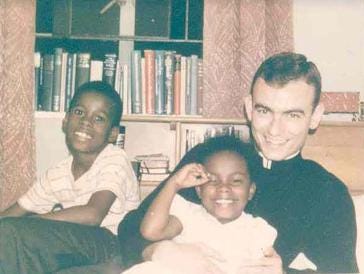
To be assaulted and imprisoned for loving our neighbors and speaking the truth is a longstanding Christian tradition- dating back to John the Baptist, dating back to Paul, who was imprisoned for setting an enslaved girl free from a demonic spirit and causing her enslaver economic loss- and it is one we are invited into. It’s one that Jesus calls blessed.
And I think if Jesus were here he might say to us
Repent, for the kingdom of heaven has come near, and in that kingdom
Blessed are the tear-gassed toddlers.
Blessed are the grocery deliverers.
Blessed are the moms and dads guarding the school gate.
Blessed are those who hold their phones, cameras filming, and bear witness.
Blessed are those who can still cry, who haven’t grown numb.
Blessed are the refugees.
Blessed are those who are judged guilty simply because of the color of their skin or the accent of their speech.
Blessed are those who can’t safely leave their homes.
Blessed are the midwives attending homebirths and the lawyers donating their time.
Blessed are the keepers of the spreadsheets and the organizers of the hygiene bank and the distributors of whistles.
Blessed are those who bring hot chocolate and hand warmers.
Blessed are you when you stand side by side with the persecuted,
whether in person or in prayer or in PayPal donations,
for Jesus stands there with you.
Take a deep breath.
We
overwhelmed
battered about by political powers and the devil and disease
are blessed
are invited to believe in a kingdom where death and despair will not have the last word
For God is with us
And God is for us
And we are for each other
And we are blessed.
On immigration and hospitality, previously:
Humble Hearts, Open Hands: a call for Christ-Centered Hospitality
Loving Our Syrian Neighbors: What We Can Learn from the Betsy-Tacy Books
Other real people I’m listening to:
I live in Minneapolis, by Elizabeth Berget (if you feel uncertain as to what’s going on there and how to think about it, I also recommend listening to her on this podcast with Laura Kelly Fanucci)
Any and all updates from Chris Gehrz, a history professor at Bethel
Matthew Soerens from World Relief
Related stories I’m watching:
On Tuesday, the Trump administration plans to eliminate Temporary Protected Status for Haitian immigrants. They are here legally: “Haitians were initially granted temporary protected status after Haiti’s earthquake in 2010 killed 222,570 people. The Biden administration extended Temporary Protected Status to Haitians in 2021 after the assassination of Haiti President Jovenel Moïse.
Gang violence, political instability, and hunger make it unsafe to return to Haiti.”
But those who are legal today won’t be on Wednesday, and ICE will move in and begin deporting them.
The Governor of Ohio “has said often talked about how the Haitian people are contributing to Springfield’s economy. “They are reliable,” DeWine told reporters in December. “They show up, they work, they want overtime, they’re reliable, and they pass drug tests.”"
How is changing the Haitian’s status helpful to Ohio?
(Remember those lies JDV told?)
(And how this connects to the American missionary legacy.)Fear of ICE is keeping pregnant immigrants in Minnesota from critical care
‘No humanity’: Detainees describe conditions inside Whipple Federal Building
ICE Begins Buying ‘Mega’ Warehouse Detention Centers Across US
Give:
This GoFundMe run by five churches
Much love to all who read all the way down, and to all whose hearts are aching, from my snowy birdhouse to yours.

A number of leaders from my church have spoken in the last week; I’m grateful for all of them and also would quibble with most all of them in one way or another. Here, I feel uncomfortable with the “we” in this sentence, which seems to me can only mean “white Christians,” even though later he is explicit that curtailing religious freedoms for immigrants is also curtailing religious freedoms for “us.”
I won’t quibble by saying that he’s being overdramatic, though. For months, clergy have been barred from visiting detainees or taking communion to them. Clergy have been arrested and assaulted for peaceful protest. Our religious freedoms are being curtailed.
Here are some of the other statements:
A Joint Letter from 154 Bishops of The Episcopal Church: Whose Dignity Matters?
Andy Doyle, Bishop of Texas: An Embodied Christian Call to De‑escalation, Dignity, and Truthfulness in Immigration Enforcement
Bishop Price of Dallas: Prayers for Diocesan Parishioners Held in Immigration Detention
Bishop Hirschfield of New Hampshire: Get Your Affairs in Order
Bishop Jose McLoughlin of Western North Carolina: Diocesan Letter
Bishop Loya of Minnesota: Facebook post
Bishop Whitworth of Massachusetts: Pastoral Message
Scott White, Rector of Trinity: Because you asked: a few words on immigration
I exhaled a profanity after finishing this. It was a prayer. This is so good, just like you.
I miss finding you on Substack. Thank you.